

In the pharmaceutical industry, quality is not just a requirement: it is a responsibility. Every tablet, every blister, every package must meet the highest standards to ensure patient safety and regulatory compliance.
Today, in 2026, this level of quality is expected. It’s the baseline. But what is often overlooked is the journey that made it possible.
Behind what we now consider state-of-the-art inspection lies decades of innovation: a path that has led to HQBlister+, the latest evolution of the Harlequin system.
This article is just the beginning of that story: a first step into understanding how this technology was built over time. In the coming chapters, we will dive deeper into its technical foundations and innovations.
But before we do that, let’s take a step back.
A journey built on experience: from black & white to intelligent vision
To fully understand today’s inspection technologies, it helps to look at their evolution through three key phases:
- The Black & White Era, where systems were limited to greyscale images and basic detection.
- The Colour Era, where RGB vision introduced surface inspection but also new challenges.
- The AI Era, where systems moved from detection and measurement to true understanding.
Each phase didn’t replace the previous one - it expanded it, solving limitations while adding new capabilities.
Harlequin was developed as a versatile vision platform, designed to address multiple inspection needs; however, its architecture and capabilities proved particularly powerful in pharmaceutical blister inspection, where precision, repeatability and reliability are critical. It is in this context that Harlequin truly expressed its full potential.
Over time, this strong positioning naturally led to a new name: Harleblister - a designation that reflects its specific application focus, highlighting where the technology delivers its highest value.
The starting point: the Black & White Era
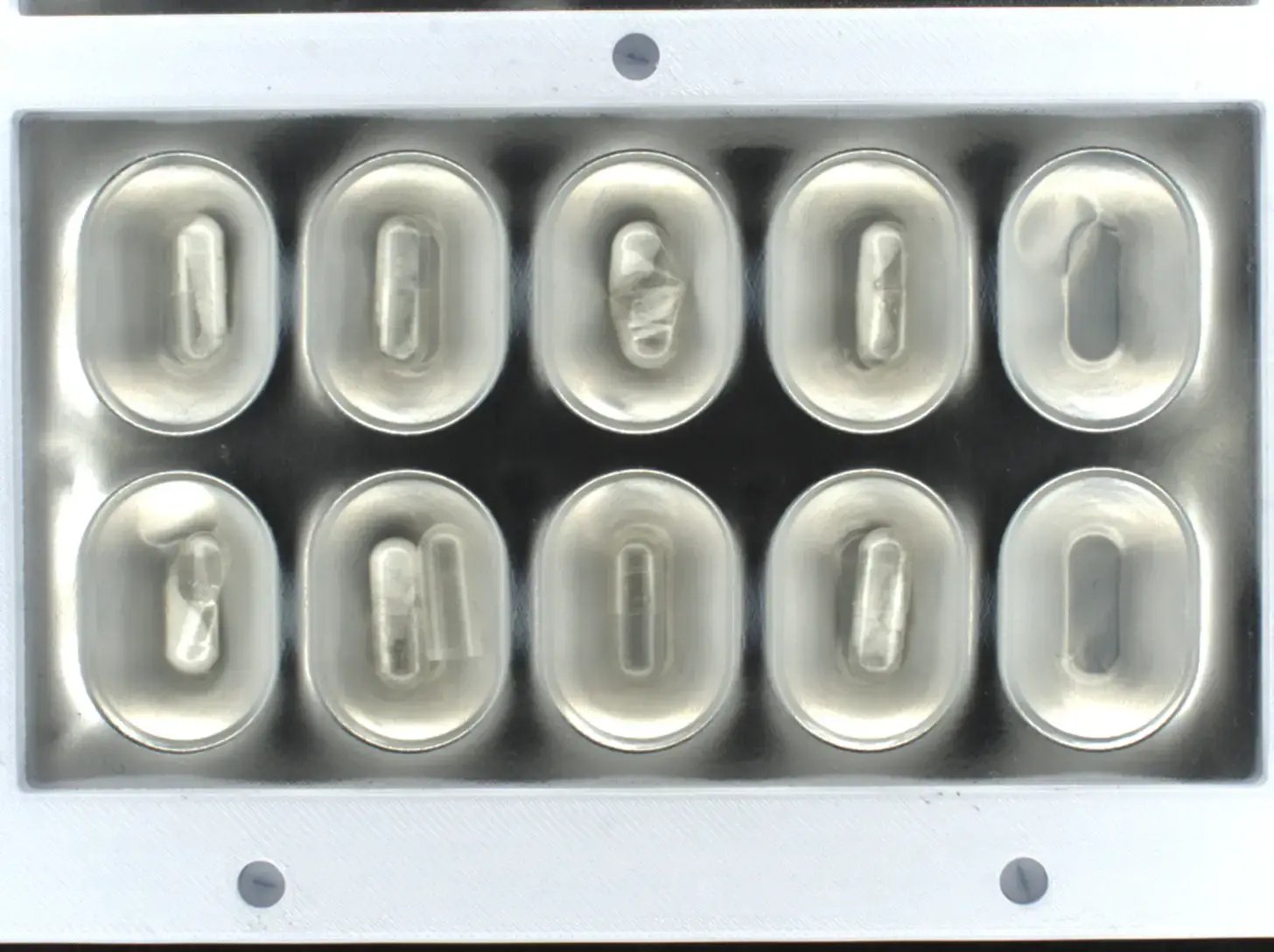
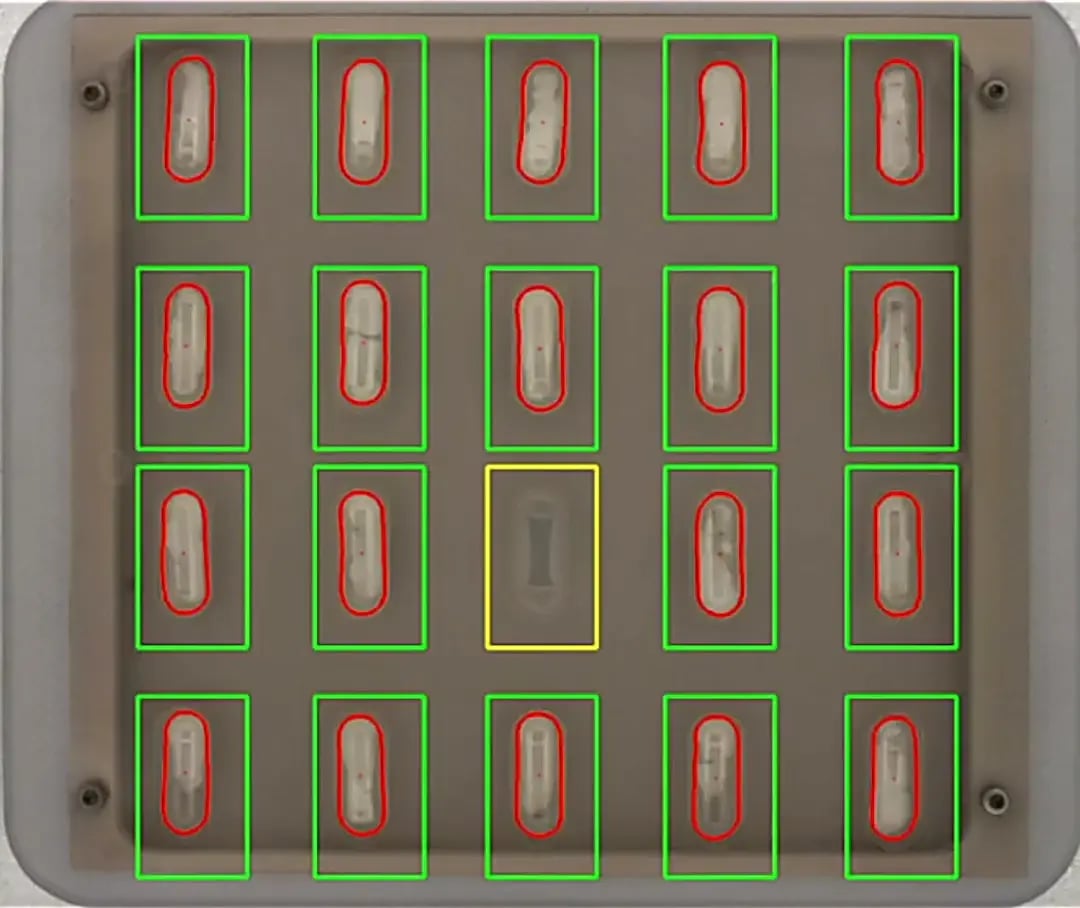
The story begins in a technological era shaped by limitations. In the early stages of machine vision, when colour imaging was not yet available or reliable, many systems relied on black-and-white acquisition combined with bottom lighting.
This approach worked for transparent materials, but completely failed with alu-alu blisters.
Light would pass through the structure without revealing the tablet, making it extremely difficult to distinguish shape or presence.
Harlequin took a different direction from the very beginning, adopting top lighting as its core approach, enabling the creation of contrast where others could only generate flat images.
The result, for most systems of the time, was clear:
- tablets were barely distinguishable;
- contrast was minimal;
- presence detection was unreliable;
Systems could “see” only basic shapes and even that was often insufficient.
This limitation defined the first phase of inspection technology and it was exactly what triggered innovation.
The breakthrough: from Seeing to Understanding
Harlequin changed the rules.
Its “superpower” was simple, but revolutionary: it could measure with precision, stability and repeatability. While other systems struggled just to “see,” Harlequin took a crucial step further - it focused on understanding.
It didn’t just check if a product was present. It analyzed it.
This marked the transition from the black & white era to a new level of inspection:
from “Is something there?”
to
“Is it exactly what it should be?”
Measurement as the turning point
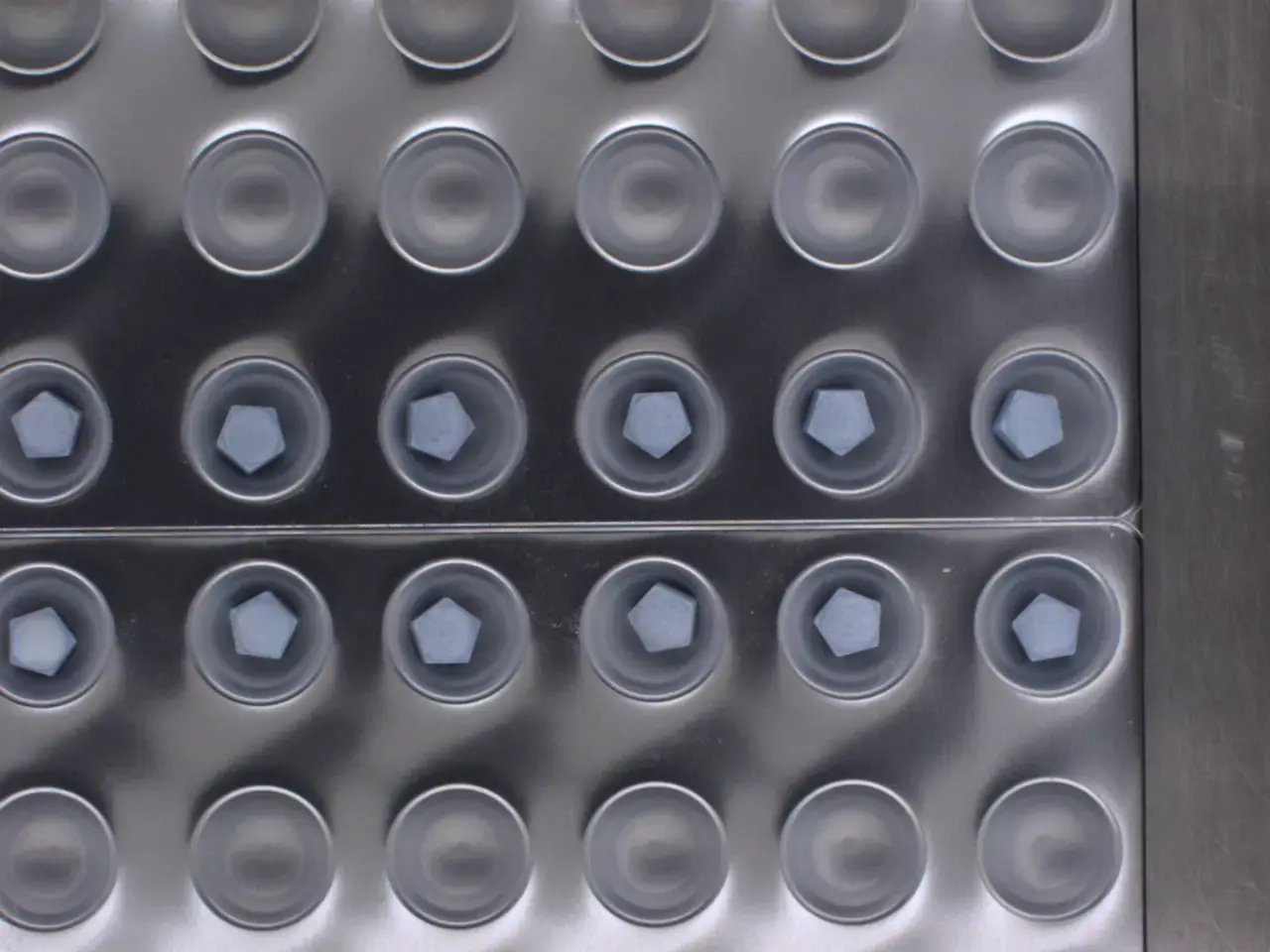
At its core, this meant evaluating both geometrical and pictorial parameters.
On the geometrical side, Harlequin could precisely measure:
- area;
- shape descriptors (F1, F2, F3, F4);
- angles and lengths;
- specific geometries such as hexagonality or pentagonality.
But it went further.
It also analyzed pictorial information, even within greyscale images:
- Grey level analysis, much like in black-and-white cinema: even without color, differences in light and shadow reveal critical details. Subtle tonal variations—such as a slightly darker capsule—could be immediately detected.
- Grey dispersion, enabling the identification of surface inconsistencies
This was a fundamental shift: even without color, the system could interpret visual information.
The Colour Era: new possibilities, new challenges
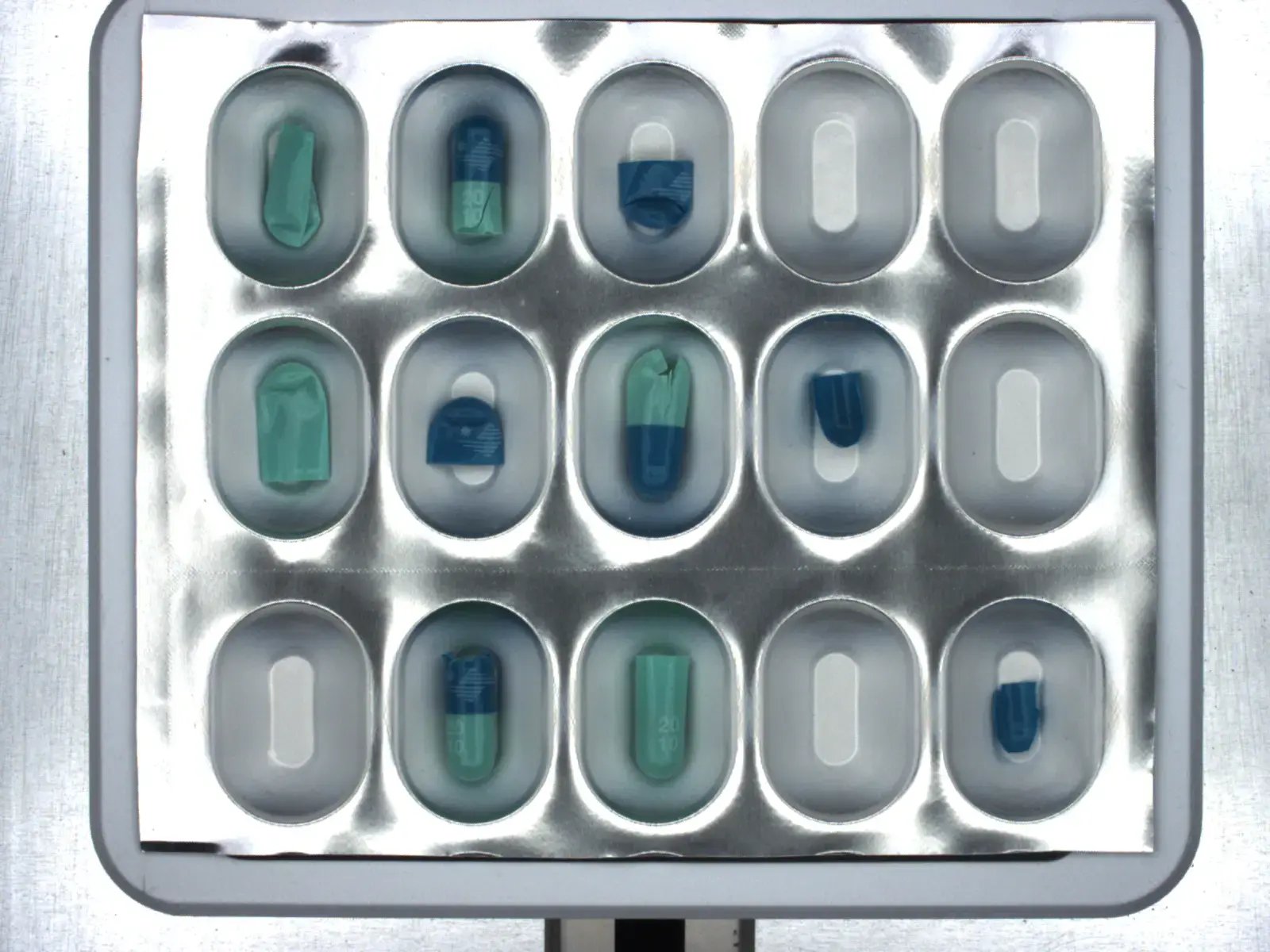
As technology evolved, RGB imaging was introduced, opening the door to color inspection.
For the first time, systems could:
- analyze coloured tablets;
- detect surface defects not visible in greyscale;
- expand inspection capabilities beyond geometry.
However, this introduced a new challenge.
Early RGB systems split images into red, green, and blue channels - but this created a paradox:
- a red tablet saturated the red channel;
- the system could not distinguish it from the background;
- the tablet effectively “disappeared”.
The result was false rejects and unreliable inspection.
Harlequin’s advantage: turning Colour into Control
Harlequin approached color differently.
Through an innovative filter-based logic, it was able to:
- create contrast even between similar colors;
- compensate for RGB limitations;
- ensure reliable detection in all conditions.
This built on its measurement foundation and extended it into the colour domain.
At this stage, Harlequin was no longer just measuring- it was interpreting complex visual scenarios.
From Measurement to Intelligence: the AI Era
Today, this evolution reaches its next stage with HQBlister+.
If the black & white era was about seeing and the colour era about measuring more,
the AI era is about understanding completely.
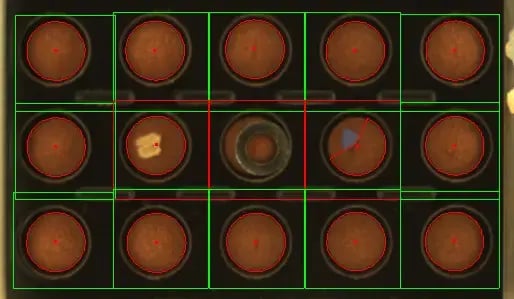
HQBlister+ builds on decades of expertise and introduces a new paradigm: learning-based inspection.
Instead of relying only on predefined rules, the system learns directly from data.
Through a training phase, it understands:
- the product;
- the blister cavity;
- background elements;
- defect patterns.
The result is a fully interpreted image, where every element is clearly classified and understood.
The next standard
HQBlister+ is the natural evolution of a journey driven by a single goal: pushing the limits of what inspection technology can achieve.
From black & white visibility, to colour measurement, to AI-driven understanding, each step has built on the previous one. Because today, it is no longer enough to simply detect defects.
What truly matters is the ability to understand, adapt and stay ahead.
And that is exactly what HQBlister+ delivers.
Request information